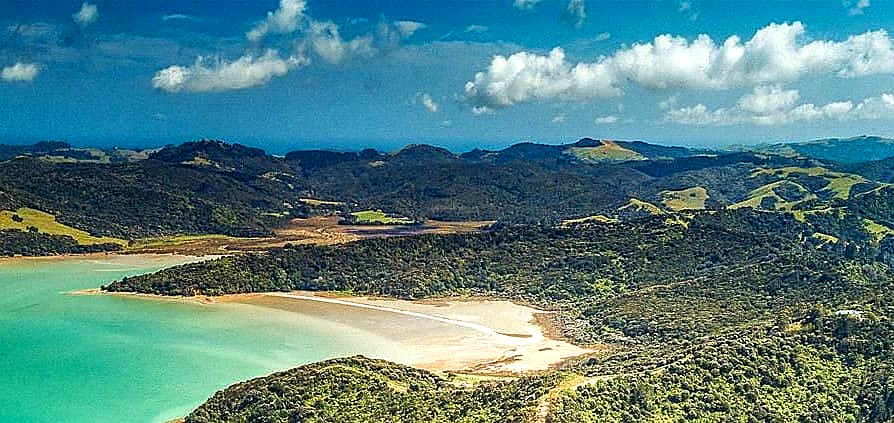
Te Matuku Bay is the highest value ecological asset on Waiheke Island — and one of the most significant coastal sanctuaries in New Zealand.
The area is unmatched locally in its comprehensive structural complexity and ecological health. It is the island's largest and least disturbed estuary, its best complete estuarine-to-forest vegetation sequence, and its most critical wading bird habitat. The three highest value wetlands on Waiheke are found here.
What makes it so special
Te Matuku dominates the island's ecological hierarchy because of its uninterrupted environmental continuity. While other areas on Waiheke are highly fragmented by urban development or farming, Te Matuku provides an intact, seamless transition from:
This rare continuity — with minimal on-going human-induced habitat fragmentation — is becoming increasingly uncommon across the Auckland Region.
Scale of protection
Uniquely, in and around Te Matuku inlet there is a critical mass of sites under public or private ownership with conservation covenants and/or active conservation management:
This includes four DOC-administered Reserves (200 acres), Te Haahi-Goodwin Reserve owned by Forest and Bird (86 acres), three Auckland Council Reserves plus esplanade reserves, at least eight significant DOC covenants including the Fenwick covenant covering 741 acres, at least five QEII covenants, and at least four Auckland Council covenants — plus many private landowners undertaking voluntary conservation on their land.
Each area under active conservation contributes significantly to the connectivity of habitats in the Te Matuku environs, linking forest with estuarine and marine zones — so the results of all conservation contributions has the potential to be far more consequential than the sum of individual efforts.
Additional factors
- Contiguous land corridors facilitate species movement across Waiheke Island and are crucial to ensuring the sustainability of Auckland Region's biodiversity as a whole.
- No possums on Waiheke — and feral goats and pigs have been eradicated. Feral deer and wallabies are absent. Te Korowai O Waiheke are implementing a stoat eradication programme across the island.
- Stricter pest plant rules — Waiheke Island has stricter pest plant control rules than the rest of the Auckland Region, with moth plant designated a "control" plant. These rules support enforcement and monitoring across the island.
- Remarkably clean marine catchment — Te Matuku's marine catchment remains extraordinarily undisturbed by urban stormwater, resulting in a rare example of unpolluted, unbroken marine-to-terrestrial ecology and a sanctuary stronghold for resilient spiny tubeworm colonies.
- Kiwi released and thriving — in 2025, kiwi were released into the Te Matuku environs. They have thrived and bred.
Flora and fauna
Within Te Matuku environs are kauri, miro, rimu, tōtara, pūriri, swamp maire, native broom and ancient pōhutukawa, along with rare fungi, native grasses and unusual native orchids.
The environment provides habitat for many rare and endangered species:
- Birds: Australasian bittern (te matuku, after whom the bay is named), NZ dotterel, reef heron, spotless crake, variable oystercatcher, bar-tailed godwit, wrybill, red knot, little penguin, banded rail, weka, kākā — and kiwi, recently released and breeding successfully
- Freshwater: banded kōkopu, giant kōkopu, longfin eel
- Marine: spiny tubeworm colonies, cockle beds, eel grass — all within the Te Matuku Marine Reserve
Significance — at every scale
🏝️ Waiheke Island
The highest value ecological asset on the island — unmatched in structural complexity, ecological health, and habitat diversity.
🌆 Greater Auckland
One of the last remaining examples of unpolluted, unbroken marine-to-terrestrial ecology in the Auckland region — a rare sanctuary from urban stormwater contamination.
🇳🇿 National scale
Elite status through its Marine Reserve and Area of Significant Conservation Value designation. A critical international hub for migratory birds and an essential breeding ground for the endangered NZ dotterel. On a par with New Zealand's most significant coastal sanctuaries.
What volunteers have achieved
Over the years Te Matuku environs were damaged — first by European settler farming and industry, then by neglect, illegal activity and firewood harvesting. Pest plants took hold and significant parts of the environment became degraded. Volunteers came to the rescue, working hard and smart to control pest plants and pest animals. Today, the DOC Reserves and many other private landholdings in Te Matuku environs are close to being pest plant free.
"Thanks to Pouteria and their forebears for your attitude, approach and above all achievements at Te Matuku. Thanks to which, pest plant management at Te Matuku is further ahead of anywhere else in the Auckland Inner Islands. I trust that the Pouteria/DOC relationship will remain as productive, with the genuine prospect of moth plant at maintenance level control in future."
— David Wilson, DOC Ranger, 2023
"I thoroughly enjoyed surveying the DOC reserve and was amazed at how weed-free it was! It was hard to believe I was still on Waiheke! You and your group have done an amazing job!"
— Karen Deyner, Ecological Consultant to Auckland Council, 2026